
A Long Way to the Fall Classic

Forty-four years since Milwaukee's last World Series. Thirty-one years since Tampa Bay was awarded a franchise. Two teams chasing a championship neither has ever won.
Baseball was designed to be a game of perseverance and poetry.
Unlike other sports where you cross a line into enemy territory to score, baseball's entire objective is to leave home, brave the dangers of the world (the bases), and safely return to where you started.
Baseball has no game clock. In theory, the innings can go on indefinitely-an escape from the rigid, micro-managed schedules of modern corporate life.
At the plate, a batter stands alone. In the field, everyone depends on everyone else. Baseball makes room for individual contribution and teamwork.
A Major League season is a 162-game marathon, with 81 games on the road. Six months of flights, hotels, unfamiliar ballparks, late nights, and early departures.
Blisters. Sore arms. Aching knees. Bruises from pitches that found anything but the strike zone. Injuries that can end a season—or a career. Winning streaks, losing streaks, injuries and trades…every season.
Imagine doing it year after year, chasing a championship that never seems to arrive. New season, new hope.
For the Tampa Bay Rays and Milwaukee Brewers, that pursuit has lasted decades. Reaching this year's World Series has required more than enduring baseball's ordinary hardships.
The long, winding road
Tampa Bay's pursuit of Major League Baseball began long before the Rays played their first game.
For years, the region tried unsuccessfully to attract a franchise. Finally, in 1995, Major League Baseball awarded Tampa Bay an expansion team. The Devil Rays took the field in 1998.
The franchise reached the World Series in 2008 and again in 2020, losing to the Philadelphia Phillies and Los Angeles Dodgers, respectively.
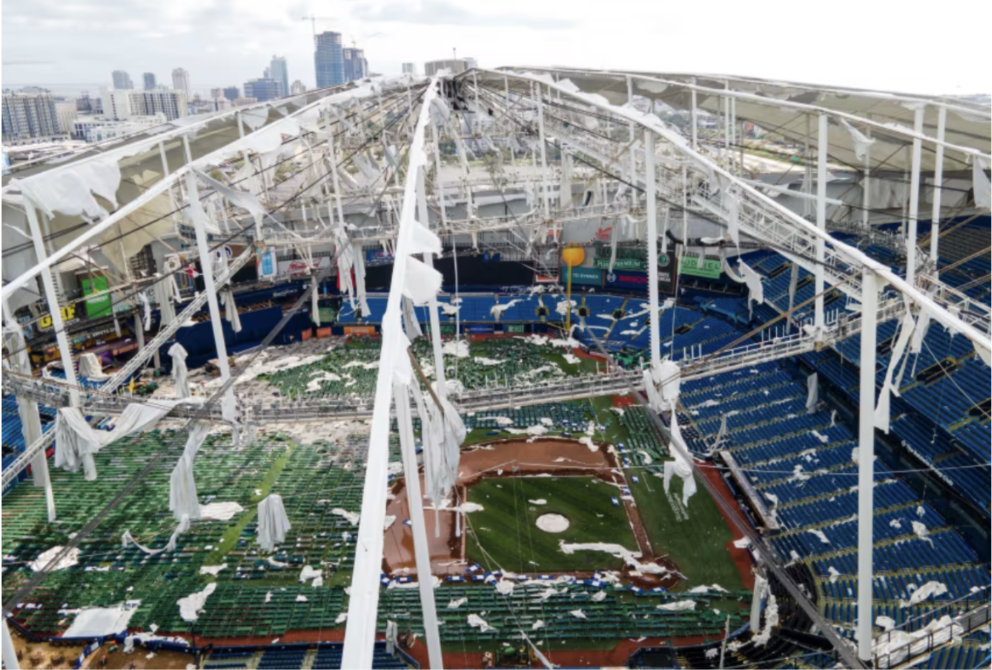
Then came October 9, 2024. Hurricane Milton swept across Florida's Gulf Coast, tearing much of the roof from Tropicana Field, the Rays' home since their inaugural season. The storm left the stadium exposed to the elements, damaging its interior and rendering it unfit for baseball.
For the Rays, an already uncertain future became considerably more complicated.
With the Trop unavailable, the team spent the entire 2025 season playing its home games across the bay in Tampa, at George M. Steinbrenner Field.
Baseball fans will appreciate the irony: Steinbrenner Field is the spring-training home of the New York Yankees, the Rays' American League East rivals and one of the wealthiest franchises in professional sports.
The Rays, whose reputation was built in part on finding ways to compete against teams with considerably deeper pockets, suddenly found themselves playing home games in the Yankees' backyard.
You couldn't make this stuff up.
It wasn't an easy season. The Rays finished 77–85, contending with Florida's summer heat and humidity and the logistical challenges of operating in a minor-league ballpark.
Meanwhile, the damaged Tropicana Field stood as a reminder of the storm and the uncertainty surrounding the franchise's future.
But the repairs progressed. On April 6, 2026, the Rays returned to Tropicana Field.
What followed was a remarkable turnaround.
Tampa Bay won 98 games, finished atop the American League East, eliminated those same Yankees in the Division Series, and defeated Cleveland to claim the American League pennant.
Now the Rays are back in the World Series for a third try, with the chance to win their first championship in the ballpark they nearly lost.
Thirty-one years after being awarded a franchise. Twenty-nine seasons on the field. And one extraordinary journey home.
Forty-four years is a long time to wait
Across the diamond, another team's fans understand perseverance.
Remember that 162-game marathon? Multiply it by 44.
That's 7,128 games' worth of waiting for Milwaukee Brewers fans since their team last appeared in the World Series in 1982. Not literally—baseball has endured strikes, shortened seasons, and other interruptions—but you get the idea.
For perspective, the Rays' entire 29-season history amounts to 4,698 games at the standard 162-game pace. Their existence fits inside Milwaukee's wait, with 15 seasons to spare.
The Brewers' story actually begins in Seattle, where the franchise spent its inaugural 1969 season as the Pilots. The team relocated to Milwaukee the following year, adopting a name that suited its new hometown.
Milwaukee made its first—and until now, only—World Series appearance in 1982.
That club, affectionately known as Harvey's Wallbangers, featured a lineup built for hitting home runs, lots of them. Robin Yount, Paul Molitor, Cecil Cooper, Gorman Thomas, and company gave Milwaukee fans a season to remember.
They also gave them a heartbreak to remember. The Brewers took the St. Louis Cardinals to seven games before losing 6-3 in Game 7.
They haven't been back to the Fall Classic since.
Forty-four years is enough time for a young fan in 1982 to become a grandparent. Enough time for generations of Brewers supporters to experience promising seasons, disappointing endings, and the annual declaration that maybe this is the year.
In 2026, that conviction finally paid off. Milwaukee won a franchise-record 103 games, then swept the defending champion Los Angeles Dodgers in the National League Championship Series.
The Brewers are back. But unlike 1982, pitching and defense, small ball, and timely hitting got them here. And unlike 1982, today's Brewers represent the National League.
A little ingenuity goes a long way
One more piece of Milwaukee trivia is worth celebrating, and it has nothing to do with former owner and MLB Commissioner Bud Selig or perseverance.
In 1977, the Brewers held a contest to design a new team logo.
The winner was Tom Meindel, an art student at the University of Wisconsin–Eau Claire, who created one of the cleverest and most enduring identities in professional sports.
At first glance, it's a baseball nestled inside a glove.
Look again. The glove is formed by a lowercase m and b—Milwaukee Brewers.
Once you see it, you can't unsee it.
The design debuted in 1978 and became inseparable from the team's identity, including that memorable 1982 season. Milwaukee eventually tried other designs, but the ball-in-glove proved difficult to beat.
A modernized version returned as the team's primary mark in 2020.
Not bad for a student design contest.
Sometimes ingenuity lasts longer than anyone expects.
A Prediction?
So here we are: two franchises—two very different journeys. One championship neither has ever won.
It isn’t “Who do we like?”
It’s more, “What are we rooting for?”
Four games in Milwaukee. Three in Tampa Bay. A seventh game that goes into extra innings, of course.
After all those seasons, miles, trades, and years of perseverance, neither team should have to go home early. There's poetry in an ending like that.
